Showing posts with label food. Show all posts

Monday, May 26, 2014

From Opium to Oolong: A Day Trip to Doi Mae Salong


The geometry of this region was just stunning.

The view from the Phra Boromathat chedi devoted to the Queen Mother.
As part of the weekly schedule at the Friendly Farm near Chiang Rai, we would work a brief morning shift on Saturdays and then had the opportunity to accompany them to the city for the late afternoon and evening, at the end of which we would meet up and ride back home. We had Sundays off.

One week, having read of the nearby historic town of Mae Salong—where some Kuomintang from China hid out following the 1949 revolution, and where one of the king’s Royal Projects has transitioned the mountain slopes’ agricultural production from opium poppy to tea and other legal cash crops, and where there’s a wat—we decided to check it out.

Having spent Saturday night in Chiang Rai so that we could rent a motorcycle and zoom up the mountain Sunday morning, we commenced our zoom: Step driving, Pil clinging with both hands to the seat-bar behind him. It was a long, buttbone-battering trip. Our poor little motorcycle huffed and puffed its way up a steep grade, and more than once I, at least, thought we were going to have to push it. We coasted on truly the ghost of fumes into a little village high on the mountain and successfully filled up the tank. “Mae Salong?” we asked, pointing at the ground where we were standing. They shook their heads and pointed farther up the mountain. Puttputtputtputtputtputt-puttputtputt...

Monday, May 5, 2014

Phonsavanh: A Study in Dust

We came to the town of Phonsavan as a staging point for our visit to the nearby Plain of Jars. Going there, you wouldn't expect such archaeological wonder to be tucked around the corner. The city itself isn't really a city, either; hardly any buildings are within twenty feet of one another and all the streets are twice as wide as normal to allow for massive freight trucks to drive through from China and Vietnam. The hotels are all Soviet block style with Chinese names and abundant neon, nearly identical down to the cavernous reception areas, awkwardly arranged with masses of heavy, carved, varnished wood furniture; like they expected a whole crowd of businessmen to storm in and have a meeting within sight of the door. At our hotel, we had an entire floor, and a very long hallway, all to ourselves, in an inexplicable corner room with no windows. Just past the lobby, an alarmingly large pile of UXO was inside a closet-sized chain-link cage that didn’t even have a solid roof.


Bomb as planter.

Even communists have gods.
There aren't enough people to fit the outsized streets and buildings of the city, that's what makes it feels so desolate. Not even the restaurants felt inhabited. We were looking for nok aen dawng, fermented swallows, and sought out one hotel restaurant where we'd read that it could be found. The dining room turned out to be tightly packed with the same heavy, shiny teak furniture as every other hotel in Phonsavanh, but it was devoid of people, besides the receptionist. The walls were the kind you find in corporate offices: tinted glass and cheap metal rims. We had missed breakfast; the cook had gone home. Nevertheless, we had a cup of (bitter) coffee and spent some time writing. Hardly any daylight made it from the lobby through to the dining room. The décor was like a strange approximation of an Americana lodge (or diner?), with license plates, animal heads, and the ubiquitous forty-year-old literal bombshells all hung neatly on the walls. We were the only customers for the hour and half we were there.


We were there in the high season, ostensibly when the most people are visiting Laos, but it felt like there was hardly anyone there (Lao, farang, or otherwise). Incongruous fields of rice and cattle divided the northern and southern halves of the town. Next to where we rented our motorbike was a run-down snooker hall with the same tinted glass office walls, packed with boisterous young Lao men drinking beer. When you add the red dust blown up from the unsealed roads, it felt, on the whole, like a Chinese-Western frontier town, the massive faux-marble floors of the all but vacant hotels towering fifteen floors above anything else. It was surreal.


Neon, weird building spacing, and massive Chinese hotel: classic Phonsavanh.

A little Soviet kitsch never hurt anyone, except for the economy.

The eerie hotel hallway.

Fermented swallows at the market.

Unfortunate slogan campaign by Pepsi in a country ravaged by UXO.

Very large house.

Recycling in action.

Donuts at the market, the only place that was ever busy.

How come communist propaganda always looks the same?

We didn't stay here, alas.

Bomb as nursery maid.

Sunday, March 16, 2014

Who Are All These People?


To bridge our transition from Thailand to Laos, it’s worth discussing our attempts to learn about the distinctions between nationality, ethnicity, and clan in southeast Asia—distinctions which are quite alive in 2014. We’ve written already about our weekend in a Karen village, and the inhabitants of that village, with whom we toiled and ate lunch for six weeks. That was just the tip of the iceberg. Many self-identifying ethnic groups coexist in Thailand and Laos, including the Karen, Akha, Hmong, Lisu, Khmu, Tai Dam, Tai Lü, Mien (also called Yao), and others. These communities exist across political borders and have spent the last few hundred years migrating to escape political oppression. In this blog, often we’ll say, “a friendly Thai man,” or “a teenage Lao girl”—but in reality many of these people might correct us, saying, “I am Akha”, “I am Hmong”, etc.

What we do know about this subject, in addition to what we’ve absorbed from talking to individuals, we’ve learned largely from several nonprofit educational centers.

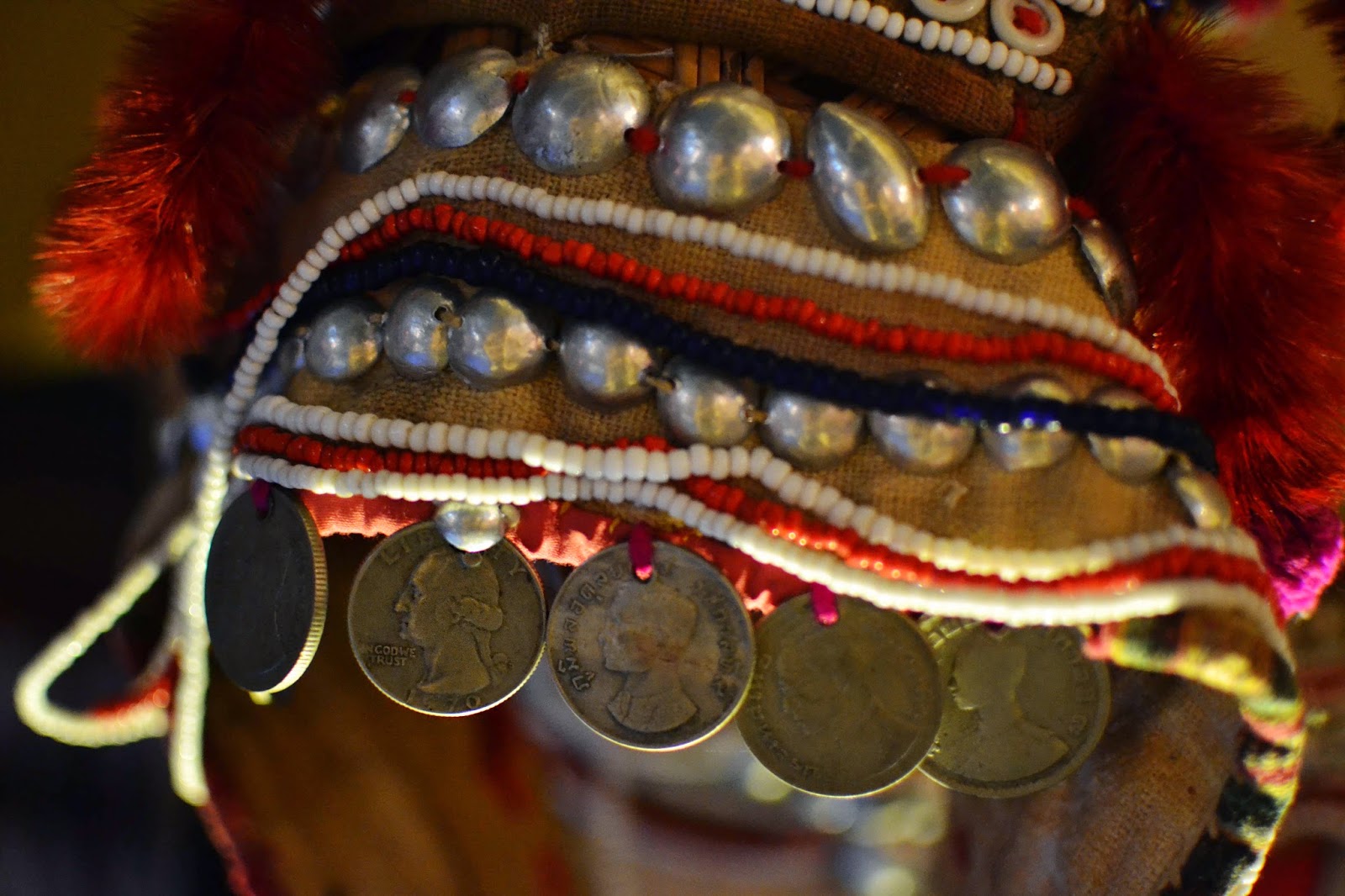
Back when we were in Chiang Mai, we made a trip to the Tribal Museum, founded in 2002 and built north of the city, in the middle of a lake. A smiling Thai woman greeted us in English and asked us to change from our outdoor shoes into indoor flip-flops provided by the museum. In the stairwell up to the first exhibit, an animatronic mannequin of a young woman in Akha dress welcomed us with limbs that moved on their own, accompanied by flashing background lights and a recorded speech in Akha. Winding our way through a series of rooms, we examined generous displays of the distinctive clothing, musical instruments, tools, houses, baskets, and so on of eight ethnic minorities currently living in northern Thailand. We saw handmade crossbows, knives, and mousetraps (like the freshly made Karen one in Baan Hoi Hoi), some truly impressive weaving and stitching work, a giant calendar comparing typical village work and celebrations for each ethnic group during any given month, and even a replica of the sacred door-sized gateway that guards the threshold of every Akha village.

Friday, March 14, 2014

The Layers of Luang Prabang


We spent eight nights in Luang Prabang, a very tourist-friendly colonial town situated at the intersection of the Mekong and Nam Khan rivers. Here are Steppil's impressions of the setting.

Wednesday, February 19, 2014

How to Eat Chiang Mai Noodles

Beef khao soi with all the fixins at Khao Soi Samerjai


The second time around, Phil and I were in Chiang Mai for six nights, six mornings, and nine breakfast bowls of khao soi. It would have been ten, except Phil felt ill one morning and, in a true demonstration of his illness, did not partake of the curative Chiang Mai Noodles. I did not waver in my devotion, and had the same (same but different!) breakfast five days in a row, at three different noodle shops, all of which were a convenient scoot-distance from our guesthouse. Although khao soi is typically a lunch or afternoon food, there were no lack of locals in any of the restaurants when we went (usually around 9 am), and it was most convenient for our long-distance itineraries to Lamphun and Wiang Kum Kam. We had to fit in our noodle fix sometime.

Saturday, February 8, 2014

Fruits on the Farm

Although we left Mae Mut Garden a few weeks ago, we still reminisce about the fresh fruit that we had every day, even during the dry season. Thailand experiences three sort-of seasons: the dry and cool (Nov-Feb), the dry and hot (Mar-May), and the wet (June-Oct). Apparently it's so abysmal in April that everyone tries to leave! Hence we've planned our trip to Burma during that period.

The dry season is the only time that watering is necessary, and even then, it's important to neglect the fruit trees a bit, because they need to feel dry in order to flower, and later bear fruit. But while we were there, plenty of fruits trees were flowering, ripening, or already giving us ready-made snacks (no pesky going to the supermarket). I took most of these photographs in one morning, with the exception of the pineapple photograph.

ทุเรียนเทศ | A new one to me, from South America, the soursop is a part of the custard apple family. Early research has shown that the leaves could have anti-cancer properties.

Sunday, January 19, 2014

Khao Tom Muu


The smell of fried garlic and steaming rice broth is what greets us on our way down to the farm house, three out of seven days. (On the other days, it’s porridge and bananas for three, and the day after we make bread, it’s toast and a plethora of jams). Khao tom means rice soup in Thai, and it’s one of the most simple, unglamorous things you could make: rice cooked in pork broth. It’s become one of my favorite things to wake up to, especially when it’s got a garden of cilantro and scallions on top.

On New Year’s Day, Nok’s best friend Nok1 fried garlic and onions to serve alongside, and made the broth using a pork bone instead of a bouillon cube. Ever since I’ve been utterly captivated, and this is absolutely one of those dishes that I’m going to keep making once we leave this continent.