Showing posts with label Hmong. Show all posts
Friday, April 25, 2014
The World's Most Heavily Bombed Nation
Before we can move from Luang Prabang to our next destination, the Plain of Jars, we need to talk about bombs. During the Vietnam War, the United States dropped over 2 million tons of explosive ordinance over Laos in 580,000 bombing missions, in an attempt to disrupt the North Vietnamese supply train. That's the equivalent of one planeload every 8 minutes, 24 hours a day, for 9 years. During the war, American bombs killed 30,000 civilians, blew up countless valuable livestock, and left thousands of villages burning. It's estimated that 30% of these bombs failed to detonate, leaving the country littered with unexploded ordinance (UXO). The worst of these are cluster munitions, which contain hundreds of individual bomblets or bombies, which are candy-colored tennis balls of lethal explosive. They look a lot like toys, and there are about 80 million of them littering the Lao countryside. This is what a cluster bomb does when it explodes:
Since the war ended, 20,000 people have been maimed or killed because of UXO explosions. Forty percent of them are children. That's about 300 people every year, almost every day. Nearly a third of the country is contaminated by UXO: all 17 of the country's provinces, a quarter of all villages, 41 of the 47 poorest districts, and a quarter of usable farmland. Subsistence farmers have no choice but to risk their limbs or their lives on their farmland, because the other option is starving. Should something happen, that person's family must somehow survive. Sometimes that means sending children to work instead of to school, furthering a cycle of poverty that has kept Laos among the 20 poorest countries in the world.
Sunday, April 20, 2014
Ock Pop Tok!
![]() |
| Different stages of the Hmong New Year skirt. |
I knew very little about weaving before coming to Laos. I still don’t know how to weave, but at least after our hours-long visit to Ock Pop Tock’s workshop in Luang Prabang, I know how it’s done, and just how complicated the doing is.
In almost every village in Southeast Asia, there are women weaving traditional textiles in dozens of ways. Some use cube-shaped bamboo looms, others use backbrace looms like the one we saw in the Karen village. In many villages, husbands build their wives custom-sized looms, combs, shuttles, and beaters. Brightly patterned cotton and silk scarves are sold at every other market stall in Southeast Asia, and half claim to be handmade. Whether they actually are, or whether the weaver was paid a living wage, are both gnarly questions.
Ock Pop Tok, which means “East and West” in Lao, sells only hand-crafted products with natural dyes, made by women paid a living wage, which is four times as much as they might be paid from another shop. The fair-trade company also develops relationships with dozens of individual villages all over Laos, and in conjunction with NGO partners, is one of the reasons why textile production lives on in these remote places.
This means that the prices are more akin to those you’d see in the West, but I’d much rather spend more knowing that I wasn’t supporting sweatshop labor in Cambodia. Most entrancingly, the workshop is open to the public, and there are free tours every day. It was one of the best days we spent in the entire country, and I learned a lot. More learning after the cut!
Sunday, March 16, 2014
Who Are All These People?

To bridge our transition from Thailand to Laos, it’s worth discussing our attempts to learn about the distinctions between nationality, ethnicity, and clan in southeast Asia—distinctions which are quite alive in 2014. We’ve written already about our weekend in a Karen village, and the inhabitants of that village, with whom we toiled and ate lunch for six weeks. That was just the tip of the iceberg. Many self-identifying ethnic groups coexist in Thailand and Laos, including the Karen, Akha, Hmong, Lisu, Khmu, Tai Dam, Tai Lü, Mien (also called Yao), and others. These communities exist across political borders and have spent the last few hundred years migrating to escape political oppression. In this blog, often we’ll say, “a friendly Thai man,” or “a teenage Lao girl”—but in reality many of these people might correct us, saying, “I am Akha”, “I am Hmong”, etc.
What we do
know about this subject, in addition to what we’ve absorbed from
talking to individuals, we’ve learned largely from several
nonprofit educational centers.
Back when we were in Chiang Mai, we
made a trip to the Tribal Museum, founded in
2002 and built north of the city, in the middle of a lake. A smiling
Thai woman greeted us in English and asked us to change from our
outdoor shoes into indoor flip-flops provided by the museum. In the
stairwell up to the first exhibit, an animatronic mannequin of a young
woman in Akha dress welcomed us with limbs that moved on their own,
accompanied by flashing background lights and a recorded speech in Akha. Winding our way through a series of rooms, we examined
generous displays of the distinctive clothing, musical instruments,
tools, houses, baskets, and so on of eight ethnic minorities
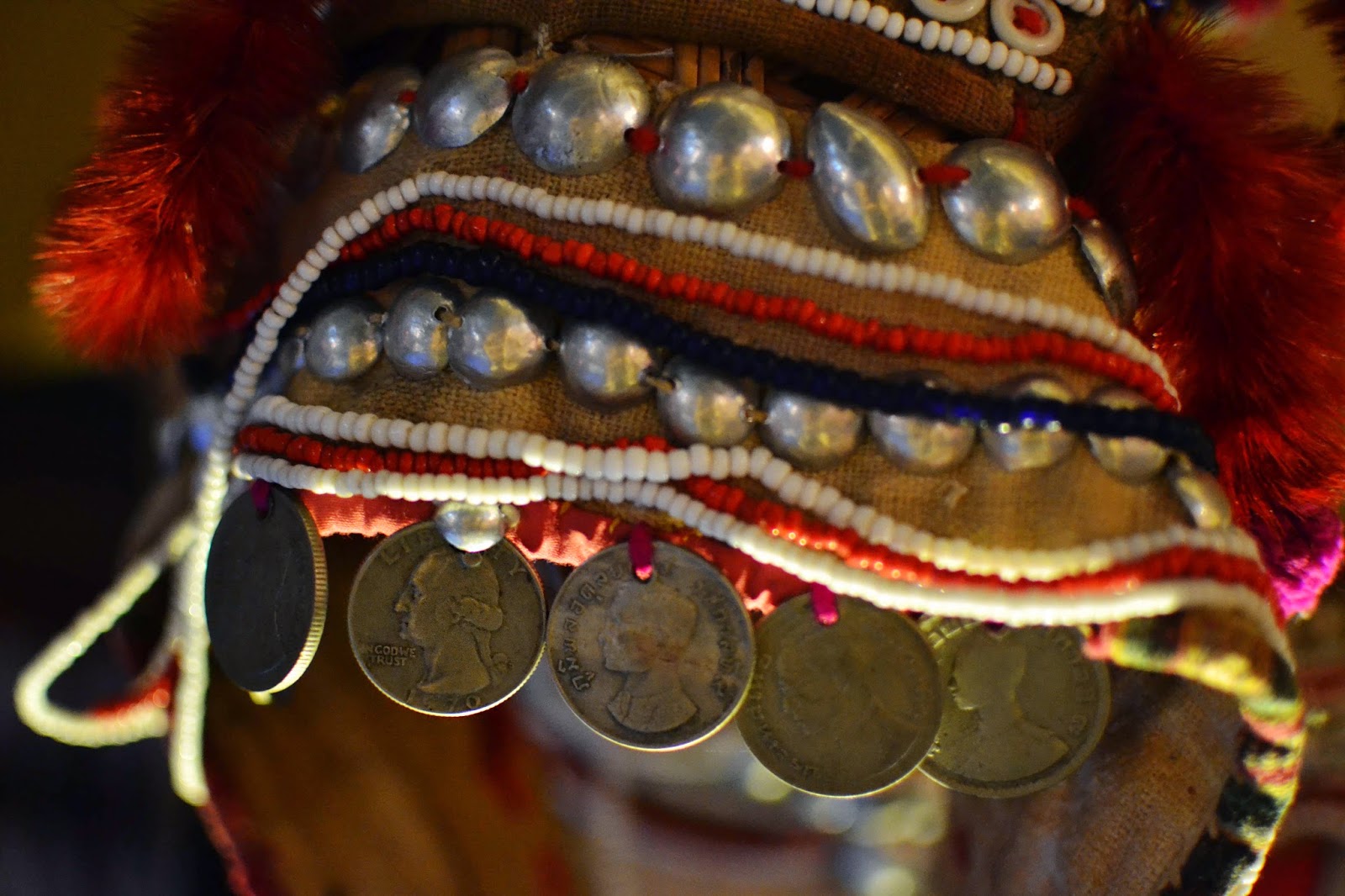
currently living in northern Thailand. We saw handmade crossbows, knives, and mousetraps (like the freshly made Karen one in Baan Hoi Hoi), some truly impressive weaving and stitching work, a giant calendar comparing typical village work and celebrations for each ethnic group during any given month, and even a replica of the sacred door-sized gateway that guards the threshold of every Akha village.
Subscribe to:
Posts (Atom)