Showing posts with label Northern Thailand. Show all posts

Saturday, February 21, 2015

The Most Metal Temple in Thailand


The main vihara

Hands reaching out from Buddhist hell. And you thought this was a peaceful religion!

Thou shalt not smoke, drink, or offend Van Halen.
Off a highway thirty minutes south of Chiang Rai, on a street dotted with coffee shops and trinket sellers, lies Wat Rong Khun, one of the most bizarre and beautiful temples ever built. Beautiful, because it's ivory white and pristinely spiky. Bizarre, because you're as likely to see an image of Hellboy as you are the Buddha.

The 12-acre complex is the creation of Chalermchai Kositpipat, who believes the best way to honor the Buddha is to have life-size cardboard cutouts of himself scattered about the property. Including in front of the gold-leafed bathroom, which along with the "Hall of Masterworks" is the only structure done in anything but white.

Thursday, February 12, 2015

The Buddhas and the Bats


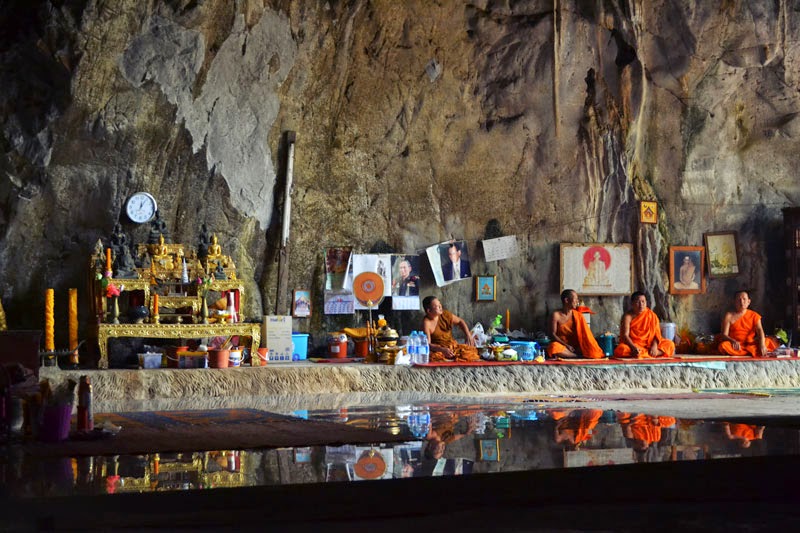
Reflections.

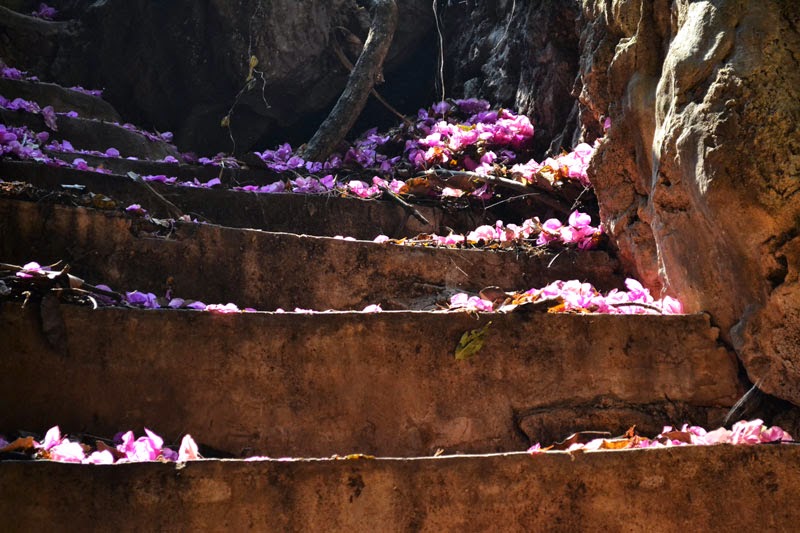
Looking down.

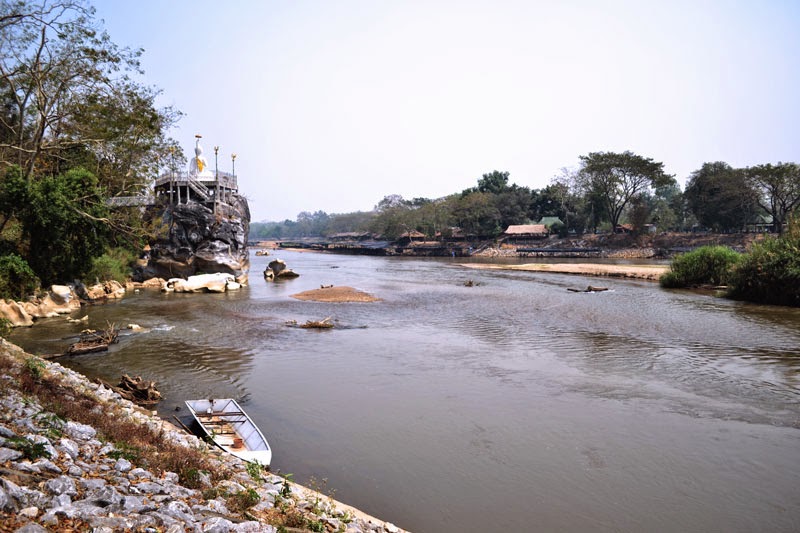
The riverbanks of Wat Tham Pu Tu.

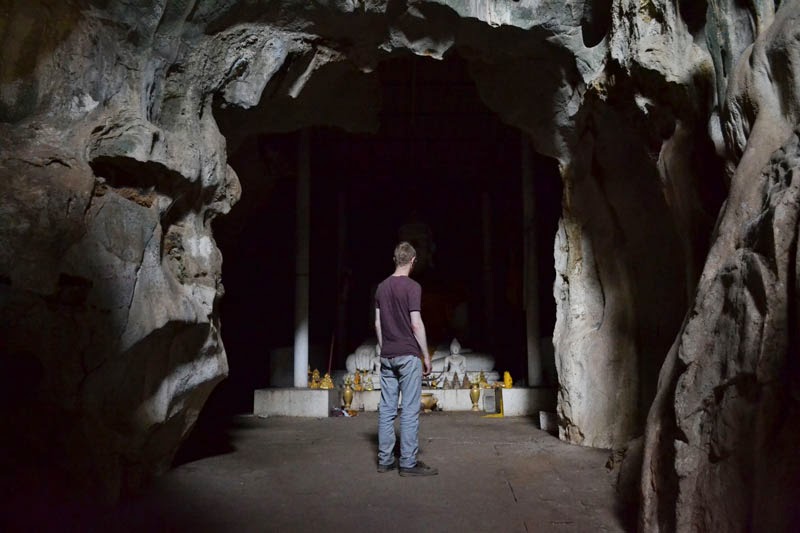
Phil considers the Buddha.
On the weekends during our time at Hans's farm, we would often rent a room for Saturday night and spend the weekend motorcycling around the countryside. One especially memorable Sunday, we took a lazy morning ride north of Chiang Rai to several caves in the hills dotting the riverbank.

The cold air of a cave takes on a religious quality in the hundred-plus degree heat of the tropics. Thais are not the only people to construct their altars in the insides of mountains, but their climate gives them the most reason to.

By the end of our travels, we would have seen a lot of caves, but these were the first. And for that, they'll always be a little special. We were the only visitors to several of these caves, excepting the scruffy guard dog to the steepest one. But at the largest one, in which the photograph above of the reflected monks was taken, a young family stepped in. There's just something about a small child's voice echoing in a cave, to the background of bats. Oh yes, how there were bats: dripping from the ceiling, clicking and chortling quietly to themselves and very rarely swooping to a new sleeping post.

That photograph of the monks is one of my favorites: the jumble of paintings and posters behind them, like a strip of a 70s living room transposed to the bowels of a mountain. And their faces! They looks so happy, so contented. The blessing they gave the young family sounded so sweet, too.

Even thinking about being there, all these months later, I feel my thoughts going slow, becoming wondering, feeling wondrous. I think of these words, by Jane Hirshfield:

An hour is not a house,
a life is not a house,
you do not go through them as if
they were doors to another.

Yet an hour can have shape and proportion,
four walls, a ceiling.
An hour can be dropped like a glass.


Monday, May 26, 2014

From Opium to Oolong: A Day Trip to Doi Mae Salong


The geometry of this region was just stunning.

The view from the Phra Boromathat chedi devoted to the Queen Mother.
As part of the weekly schedule at the Friendly Farm near Chiang Rai, we would work a brief morning shift on Saturdays and then had the opportunity to accompany them to the city for the late afternoon and evening, at the end of which we would meet up and ride back home. We had Sundays off.

One week, having read of the nearby historic town of Mae Salong—where some Kuomintang from China hid out following the 1949 revolution, and where one of the king’s Royal Projects has transitioned the mountain slopes’ agricultural production from opium poppy to tea and other legal cash crops, and where there’s a wat—we decided to check it out.

Having spent Saturday night in Chiang Rai so that we could rent a motorcycle and zoom up the mountain Sunday morning, we commenced our zoom: Step driving, Pil clinging with both hands to the seat-bar behind him. It was a long, buttbone-battering trip. Our poor little motorcycle huffed and puffed its way up a steep grade, and more than once I, at least, thought we were going to have to push it. We coasted on truly the ghost of fumes into a little village high on the mountain and successfully filled up the tank. “Mae Salong?” we asked, pointing at the ground where we were standing. They shook their heads and pointed farther up the mountain. Puttputtputtputtputtputt-puttputtputt...

Tuesday, May 20, 2014

Horses and Puppies and Roosters, Chiang Rai!


Who would have thought that I would go to Thailand to train horses? I had a conniption when I first found this farm listed on WWOOF: five horses?! I had to go. I made us go. So we went.

Appaloosa Stables, subdivision Friendly Farm LLC, is run by Hans and Aye, who have lived in Chiang Rai for nearly twenty years. They started out running a guesthouse, but Aye's Thai restaurant was so much more popular that they stopped letting people sleep there and just called it Aye's. Then Hans opened an Italian place, but expats kept storming the counter with requests for this many olives or that many slices of cheese that there's now a deli shop around back. That's three restaurants, and counting. One of the lovely perks of this arrangement was that we ate delicious leftover restaurant food (hang leh three times a week, mmm) and every Saturday headed out into town for a meal on the house and a stroll through the weekly Walking Street, which is the Thai equivalent of the mall. Everyone hangs out at the mall on a Saturday night.

Wednesday, March 12, 2014

Finding an Old City in the New City


Exactly thirty years ago, in 1984, a lost city was rediscovered beneath Chiang Mai. It all began when some residents in a suburb of Chiang Mai found some ancient Buddhist tablets next to a temple. Abandoned to floodwaters and hundreds of years of silt, Wiang Kum Kam was held to be a myth….until archaeologists realized people were living right on top of it!!!

In 1286, King Mangrai built Wiang Kum Kam on the banks of the Ping River, to be to capital of his new Lanna Kingdom. But the rainy season was not kind to Wiang Kum Kam, and just ten years later, the King relocated the capital to the opposite shore, and the new city of Chiang Mai—which, hey hey, means new city in Thai—superseded its older brother.


Pil and I scooted out there one day in January during the dry season to avoid the flood. The ruins of Wiang Kum Kam are now (metaphorically) buried in the heart of a quiet suburb to the southeast. There are landmark signs pointing you in the right direction, but we got a little lost anyway, and made our way into the first complex of ruins via the backdoor of a temple (at the insistence of a monk). We had read that you can hire a horse carriage for a palfry penny, but there were none to be seen—just a few quiet noodle stalls also selling knick-knacks, and a lone group of Thai tourists.

Friday, March 7, 2014

On Doi Suthep; or: Gold and Elephants


Wat Phra That Doi Suthep, or Doi Suthep for short, is one of the most hallowed places in Northern Thailand, built in 1383 under the auspices of King Keu Naone and his elephant. As the story goes, said elephant was carrying a sacred Buddha relic on his back, and the royal party was following behind, with the intention of building a temple on the spot where the holy elephant stopped. Well, he made it all the way to the top of the mountain, then keeled over and died. Thus the temple was built right there. It's less than an hour away by motorbike, and those switchback turns are fun!

Another fun fact: when I tell people my name is Step, it is pronounced a lot more like Suthep than the part of a staircase, so the mountain and I feel much affinity towards one another.

Wednesday, March 5, 2014

Wats the Big Deal?

Dog days at the dog wat, Wat Ketkaram.

There are a few things that Southeast Asia has in spades: chilies, bananas, stray dogs, smiles, and temples. In the past three months, we’ve stepped barefoot into more Buddhist temples than we have in our entire lives. In fact, we went from zero to fifty-odd in the span of a few weeks, and we knew virtually nothing about temple architecture or practice before we arrived. We had a lot of learning to do, and luckily we were able to participate in a full moon ceremony in Mae Mut to see what active temple life is like. But there are still hundreds of details and intricacies—the symbolism of certain architectural flourishes, mysterious numbered boxes stuffed with paper like mail slots, the meaning behind poured water—that we’re still trying to unpack. Thus we preface this post with the warning that we are not experts, have probably gotten things wrong, and could have learned a lot more had we not been petting so many temple dogs.

Each temple has its own flavor, and sometimes even its own zodiac animal theme, but common to all of them is the sense of it being a living space. What felt really special to us about all of these wats was how there were so many people there simply to worship. Even at Doi Suthep, which is crawling with multinational tourist bugs, including ourselves, there were Chiang Mai University graduates in their robes, walking circles around the chedi for merit, giggling girls shaking out fortune sticks, people bowing their heads for a monk's blessing. Even at Chiang Mai’s so-called Silver Wat, which is lit up in rotating neons at night, there are monks engaging in nightly “monk chats,” where visitors are invited to chat with disciples about the way of the Buddha. We sat in on one of these and found it interesting, if a little difficult due to language difficulties. (This was before we learned any decent amount of Thai.)

The ordination hall at Wat Ket

Wednesday, February 19, 2014

How to Eat Chiang Mai Noodles

Beef khao soi with all the fixins at Khao Soi Samerjai


The second time around, Phil and I were in Chiang Mai for six nights, six mornings, and nine breakfast bowls of khao soi. It would have been ten, except Phil felt ill one morning and, in a true demonstration of his illness, did not partake of the curative Chiang Mai Noodles. I did not waver in my devotion, and had the same (same but different!) breakfast five days in a row, at three different noodle shops, all of which were a convenient scoot-distance from our guesthouse. Although khao soi is typically a lunch or afternoon food, there were no lack of locals in any of the restaurants when we went (usually around 9 am), and it was most convenient for our long-distance itineraries to Lamphun and Wiang Kum Kam. We had to fit in our noodle fix sometime.

Monday, February 17, 2014

We Need to Talk About Chiang Mai


I should preface this post by saying that before this, I had never been to any city in Asia. Not even Bangkok, unless you count a harrowing taxi ride from the airport to the train station, where we just waited for six hours. (We’ll be taking the train back down to Bangkok at the beginning of April, so you can look forward to a funny comparison between third and first class travel. I salivate at the thought of a sleeper car.)

I can’t even say with honesty that I have been to any Asian city besides Chiang Mai, because nowhere in Laos that we have been feels anything like a city. Luang Prabang is an overgrown town with an outsize tourist population, a million wats, and European-style cafés that don’t exist anywhere else in Laos except Vientiane (where we haven’t been). The other provincial capitals we’ve visited, Sam Neua and Phonsavanh, were bewilderingly odd: like a cross between Soviet realism and a frontier town movie set, plus enough dust to coat an entire nation, not to mention my lungs and all of my clothes.

But I’m getting ahead of myself. According to this blog, we haven’t even gotten to Laos yet. Let’s get back to Thailand.

Saturday, February 8, 2014

Fruits on the Farm

Although we left Mae Mut Garden a few weeks ago, we still reminisce about the fresh fruit that we had every day, even during the dry season. Thailand experiences three sort-of seasons: the dry and cool (Nov-Feb), the dry and hot (Mar-May), and the wet (June-Oct). Apparently it's so abysmal in April that everyone tries to leave! Hence we've planned our trip to Burma during that period.

The dry season is the only time that watering is necessary, and even then, it's important to neglect the fruit trees a bit, because they need to feel dry in order to flower, and later bear fruit. But while we were there, plenty of fruits trees were flowering, ripening, or already giving us ready-made snacks (no pesky going to the supermarket). I took most of these photographs in one morning, with the exception of the pineapple photograph.

ทุเรียนเทศ | A new one to me, from South America, the soursop is a part of the custard apple family. Early research has shown that the leaves could have anti-cancer properties.

Friday, February 7, 2014

A Buddhist Full Moon Service

Just to keep you on your toes about the details of our lives, welcome to a bonus post (it’s shorter I promise) from the thus far ghostwriterly Pil.

Another of the illuminating and heartwarming community experiences from our time at Mae Mut Garden was the full moon service at the local temple, Wat Wimuttikaram. As we may or may not have mentioned at some earlier time (I am illiterate), there are a lot of wats everywhere we’ve been in Thailand so far. If they were not large walled estates containing several buildings, you’d basically be tripping over them. They are fascinating, beautiful places with many doors, and we’ll have more to say about them in future posts. The point, for now, is that Wimuttikaram is the wat nearest to the house of Marco, Nok, and Her Imperial Highness Serena.

The first we heard of the service was the day before, when Nok invited us. That night, after the Ruler of All had fallen asleep, Steppil + Nok assembled small plastic bags containing smaller packets of rice, noodles, and instant coffee. These bags, Nok explained in a low voice so as not to wake the Serena-monster, are gifts that serve a double purpose. They are a contribution toward our own nourishment in future reincarnations—but in this lifetime, they are also presented as a gift to the hungry poor of the village.

Every family also offers flowers, which are added to communal decorative platters and somehow look like hour-long arrangements, despite being the work of minutes. The pink ones on the right were ours.

Finding Nemo in a Karen Village


If some unspeakably cruel person were to hold me hostage and forced me to choose my top five experiences in Thailand thus far, I would think this person an exceedingly dull villain. It's hard to choose. I would talk about reaching the highest shrine in Thailand, the lights over the Ping River, the dogs of Mae Mut greeting me every morning with wagging tails, I would talk about my brush with the divine when I first slurped Chiang Mai noodles in Chiang Mai, and then I would then launch into the story of the weekend that Phil, Molly, and I spent in Baan Hoi Hoi, the Karen village nearest the farm.

Tuesday, January 21, 2014

No Hinting. Stay on Trial.


At Mae Mut Garden, we typically work six days per week and take Sunday off. (Partly this is because the Karen staff, being Christian, take Sunday off anyway.) On our Sundays, we go out and see the surrounding area. The first two times, Step and I went out on a motor-scooter by ourselves, to chase those infamous waterfalls. Since then, we have been fortunate enough to go out with the whole family, including Pii Hom and her 14-year-old daughter, Nong Nam.

No hinting.
Stay on trial.
Don't write.
One of our recent such outings was to Mae Wang National Park—home of strange, amazing sandstone-like formations as well as many ambitious pebbles. Originally, weeks ago, we had been discussing the aforementioned Sundays-out-in-the-world plan after lunch. Marco disappeared into the house and brought out a glossy tri-fold brochure with beautiful photos of this place and much writing in Thai. “Where is this?” he asked one of the staff in Thai, pointing at the photo, and thus our adventure was born.

Fast forward. After breakfast and watering, we pile in the pickup truck. In the cab, we have Marco, Nok, Her Highness Serena, Pii Hom, and Bruno. In the bed, facing backwards and waving at two intrepid Thai children doing the same thing but standing up, we have Step, Molly (our super-co-volunteer—American, my age, superb company, former New Orleans mule driver and tour guide), and Pil. We just go where they take us, you know? As we rumble down the road, all four dogs sprint after us. We discuss the logistics of stealing one and bringing it to Burma. We do not. (Editor’s Note: We haven’t gone to Burma yet, so the possibility has not been ruled out, and also, it’s not stealing if every other day your host tells you to take every single dog except for Spaghetti.)

Sunday, January 19, 2014

Khao Tom Muu


The smell of fried garlic and steaming rice broth is what greets us on our way down to the farm house, three out of seven days. (On the other days, it’s porridge and bananas for three, and the day after we make bread, it’s toast and a plethora of jams). Khao tom means rice soup in Thai, and it’s one of the most simple, unglamorous things you could make: rice cooked in pork broth. It’s become one of my favorite things to wake up to, especially when it’s got a garden of cilantro and scallions on top.

On New Year’s Day, Nok’s best friend Nok1 fried garlic and onions to serve alongside, and made the broth using a pork bone instead of a bouillon cube. Ever since I’ve been utterly captivated, and this is absolutely one of those dishes that I’m going to keep making once we leave this continent.

Friday, January 17, 2014

An Interview with Two Village Elders

This morning, Phil and I spent three hours clearing around tree trunks, piling on cow shit, and then rearranging hoses. This afternoon, we played with colored pencils. “There are a lot of things that you can do that don’t involve a shovel,” Marco told us at the beginning of our stay here. So Phil has been working on a map of the watering system here, which is complex, and includes a spot on the map lovingly referred to as the Land of Five Valves, because all the trees there are on a drip-line—no hoses! I've been drawing a kind of welcome map of the property, so that nobody gets lost in a banana grove when they come to the farm for a visit.

Last week, we had an especially cool project, with Marco immediately suggested after we said that we were writers. (Mostly out of relief that he could begin having us write his blog posts for him). We interviewed two village elders, Ooey Khambao (age 84) and Ooey Jum Supaeng (age 77), and wrote up what the village was like when they were born and how it's changed. (Ooey is a Thai term for grandmother or elder that precedes their name.)1

So with Marco and Nok translating (and, of course, in turn fielding questions about Empress Baby Serena), we wrote a story that synthesizes their voices and their experiences. There's probably a little that we missed, but we tried to catch it all, and swear that we didn't make anything up, not even the tigers.

Two Village Elders


Tuesday, January 14, 2014

Like a Ton of Bricks. Or A Pit.

Every day when we head back up to the house to shower, Phil and I are faced with an insurmountable number of bricks. The first day we were so impressed to learn that they were made by hand, and we were even more impressed later when we saw them in action, and realized that they were also made by foot. And now, we've made them ourselves!

Something like 2500 bricks are going into the addition to the farmhouse, which is being built now. It's been awesome to see the ground go from being shaded by an enormous banana tree, to being a square of cement, to being a skeletal brick frame, to reaching over our heads. The biggest lesson we have taken away from this: "Be very careful where you plant banana trees. They are a piece of work when you want to get them out."

Friday, January 3, 2014

I Ate All of the Bananas on Doi Pha Ngaem (ดอยผาแง่ม)

©2013 Stephanie Bastek

Happy New Year! To celebrate, the whole Mae Mut Garden Gang climbed up to the highest Buddhist shrine in Thailand, on Doi Pha Ngaem. The whole time we were hiking, I was deceived that this was Doi Inthanon, the most ultra prominent peak in Thailand, and even repeated multiple times in Thai, "We are hiking up Doi Inthanon, I am very tired!" but I guess I pronounced "Inthanon" with such mangled tones that it was perceived to be farang1 gibberish.

Tuesday, December 24, 2013

Don't Go Chasing Waterfalls, Because You Will Get Lost Repeatedly

Yesterday, Phil and I used our day off to hit the Mae Sapok Waterfall (nam-tok mesa-pohk; น้ำตกแม่สะป๊อก). Except first we hit a few potholes, and then we hit the sign for the Mae Sapok Waterfall, and then we didn't hit the Mae Sapok Waterfall, we hit a mini-waterfall, because if experience has taught us anything, is that we are terrible at finding waterfalls. Last week we tried to find this same waterfall and instead ended up at the Mae Wang Waterfall, where my camera died capturing Phil walking across a narrow bamboo bridge. It's an accurate depiction of how this feat made my stomach feel.

Image taken in-camera, no Photoshop applied.
Well, this week we decided we'd do it right. We followed Marco's directions to a tee, and then came to a sign that said in Roman characters (in addition to a thousand Thai ones): MAE SAPOK WATERFALL. We registered that it was in 500m, but failed to register the arrow pointing right. So we turned left.

Friday, December 13, 2013

We're Alive!

Saawaatdee kha(p) from Mae Mut Garden! It's been exactly a week since we arrived in Thailand, and so much has happened in the past six days that there are a dozen different ways this post could go. After two days on planes and in airports, we took a fourteen-hour train ride from Bangkok up to Chiang Mai, and stayed there for a few days. We'll write about Chiang Mai in a bit--this is what we're up to right now.

On Monday, Marco picked us up in Chiang Mai, along with his Italian cousin Bruno, and together we filled the car with a babble of English, Italian, and broken Romance languages. We've figured out a haphazard system of triangulation using Phil's Spanish, my French, and Bruno's iPhone app for English. (Marco is fluent in English and Thai, like his wife Nok, and eventually their baby Serena). It's worked well enough for Bruno to give me a refresher course on how to ride a motorcycle!

Marco and Nok's farm is in Mae Wang, about an hour southwest of the city. The loud city advertisements and traffic evaporated after the highway, along with any trace of English. On the train up from Bangkok, we had a sense of the green giants around us, but it's nothing like being nestled in the crook of a mountain range. Everywhere we look it's just mountains, going endlessly back like a hall of increasingly foggy mirrors. We wake up every morning to dew on our shoes and the village loudspeaker announcing the news through the mist.