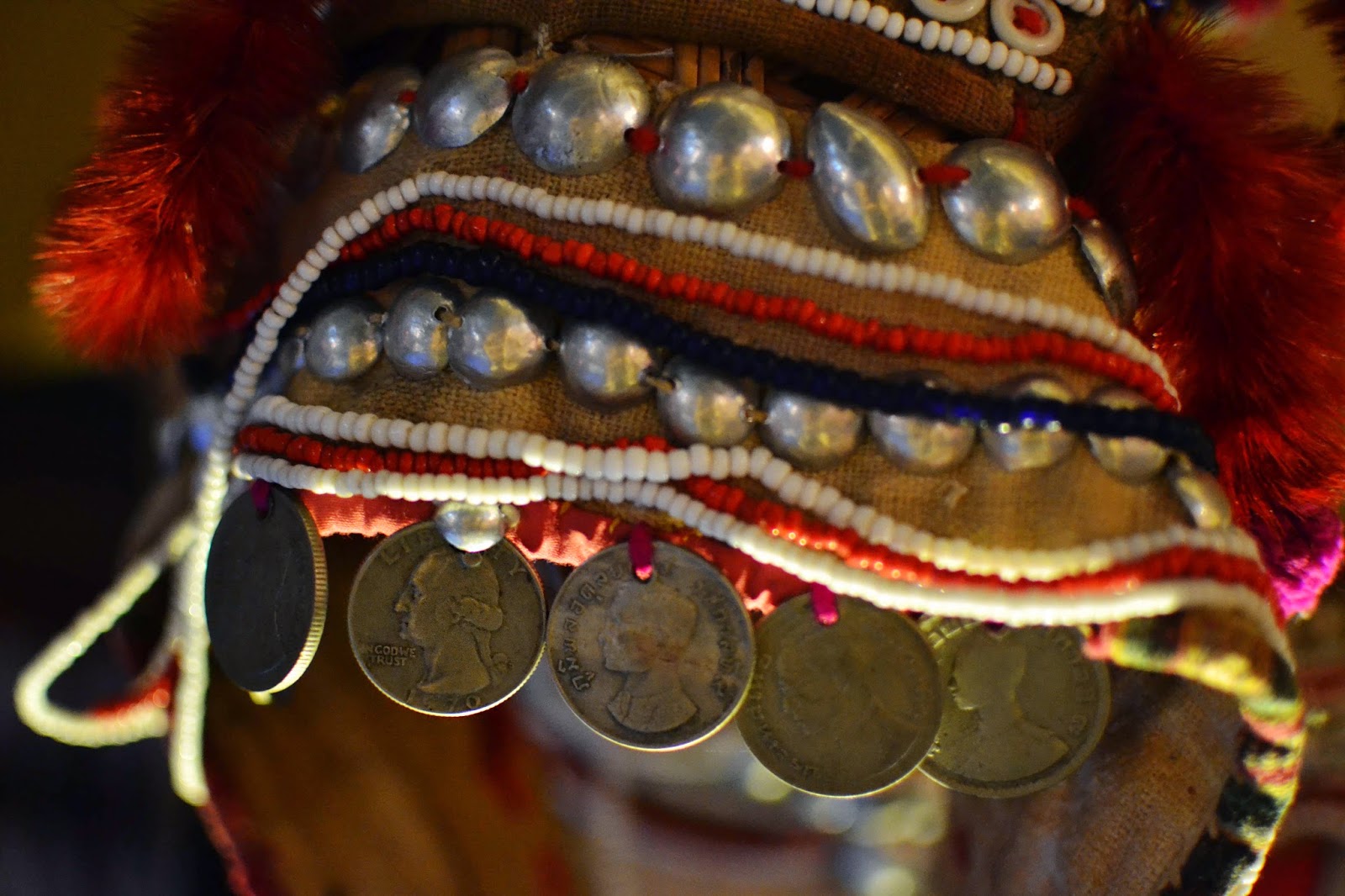
Off a highway thirty minutes south of Chiang Rai, on a street dotted with coffee shops and trinket sellers, lies Wat Rong Khun, one of the most bizarre and beautiful temples ever built. Beautiful, because it's ivory white and pristinely spiky. Bizarre, because you're as likely to see an image of Hellboy as you are the Buddha.
The 12-acre complex is the creation of Chalermchai Kositpipat, who believes the best way to honor the Buddha is to have life-size cardboard cutouts of himself scattered about the property. Including in front of the gold-leafed bathroom, which along with the "Hall of Masterworks" is the only structure done in anything but white.
Saturday, February 21, 2015
Thursday, February 12, 2015
The Buddhas and the Bats
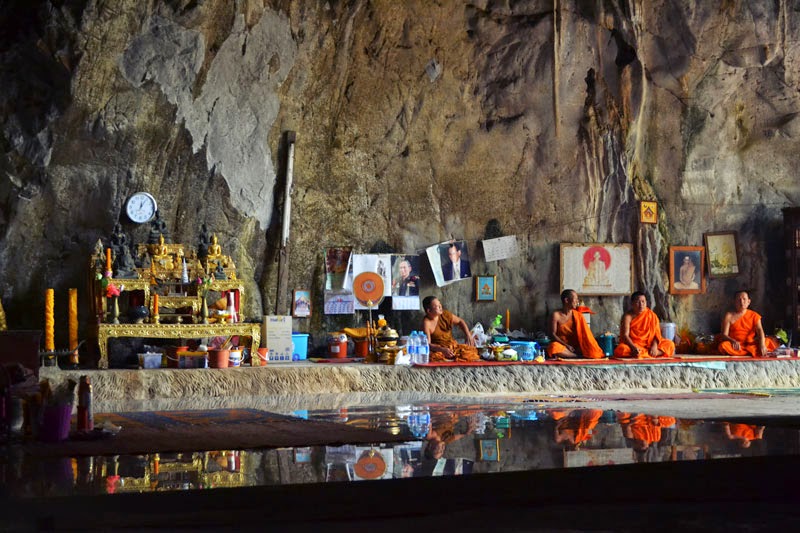
Reflections.
Looking down.
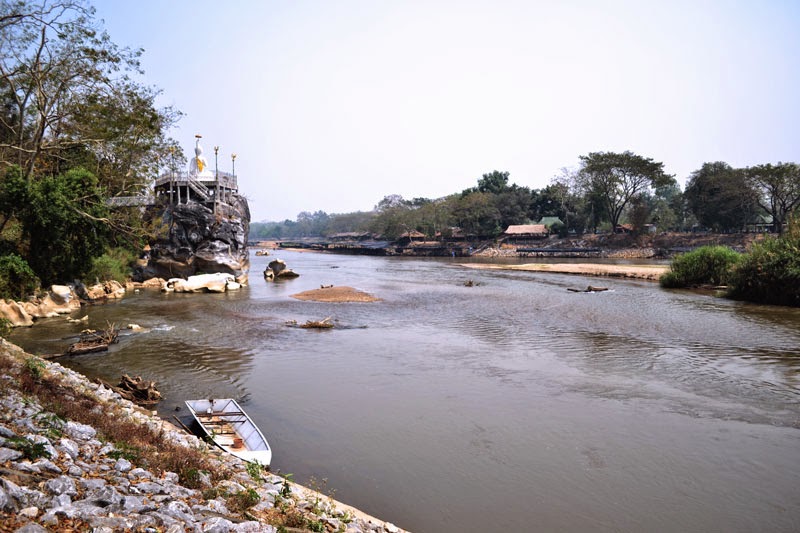
The riverbanks of Wat Tham Pu Tu.
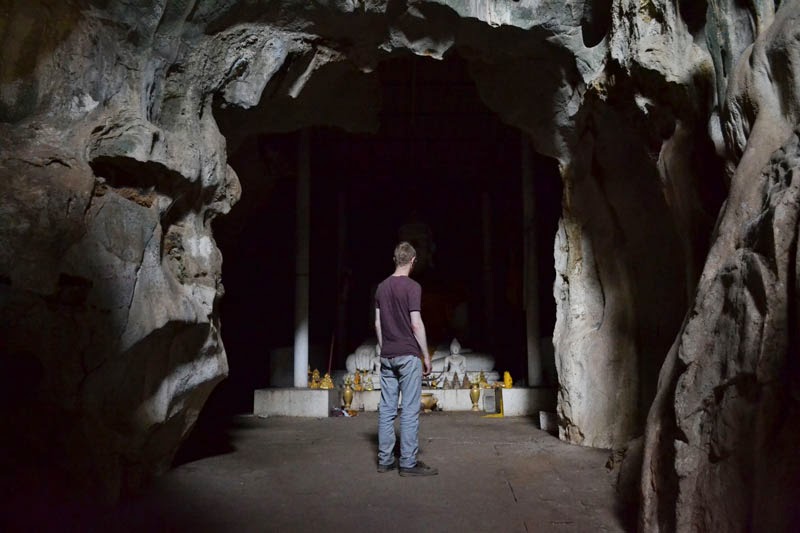
Phil considers the Buddha.
The cold air of a cave takes on a religious quality in the hundred-plus degree heat of the tropics. Thais are not the only people to construct their altars in the insides of mountains, but their climate gives them the most reason to.
By the end of our travels, we would have seen a lot of caves, but these were the first. And for that, they'll always be a little special. We were the only visitors to several of these caves, excepting the scruffy guard dog to the steepest one. But at the largest one, in which the photograph above of the reflected monks was taken, a young family stepped in. There's just something about a small child's voice echoing in a cave, to the background of bats. Oh yes, how there were bats: dripping from the ceiling, clicking and chortling quietly to themselves and very rarely swooping to a new sleeping post.
That photograph of the monks is one of my favorites: the jumble of paintings and posters behind them, like a strip of a 70s living room transposed to the bowels of a mountain. And their faces! They looks so happy, so contented. The blessing they gave the young family sounded so sweet, too.
Even thinking about being there, all these months later, I feel my thoughts going slow, becoming wondering, feeling wondrous. I think of these words, by Jane Hirshfield:
An hour is not a house,
a life is not a house,
you do not go through them as if
they were doors to another.
Yet an hour can have shape and proportion,
four walls, a ceiling.
An hour can be dropped like a glass.
a life is not a house,
you do not go through them as if
they were doors to another.
Yet an hour can have shape and proportion,
four walls, a ceiling.
An hour can be dropped like a glass.
Monday, May 26, 2014
From Opium to Oolong: A Day Trip to Doi Mae Salong
The geometry of this region was just stunning.
The view from the Phra Boromathat
chedi devoted to the Queen Mother.
One week, having read of the nearby historic town of Mae Salong—where some Kuomintang from China hid out following the 1949 revolution, and where one of the king’s Royal Projects has transitioned the mountain slopes’ agricultural production from opium poppy to tea and other legal cash crops, and where there’s a wat—we decided to check it out.
Having spent Saturday night in Chiang Rai so that we could rent a motorcycle and zoom up the mountain Sunday morning, we commenced our zoom: Step driving, Pil clinging with both hands to the seat-bar behind him. It was a long, buttbone-battering trip. Our poor little motorcycle huffed and puffed its way up a steep grade, and more than once I, at least, thought we were going to have to push it. We coasted on truly the ghost of fumes into a little village high on the mountain and successfully filled up the tank. “Mae Salong?” we asked, pointing at the ground where we were standing. They shook their heads and pointed farther up the mountain. Puttputtputtputtputtputt-puttputtputt...
Tuesday, May 20, 2014
Horses and Puppies and Roosters, Chiang Rai!
Who would have thought that I would go to Thailand to train horses? I had a conniption when I first found this farm listed on WWOOF: five horses?! I had to go. I made us go. So we went.
Appaloosa Stables, subdivision Friendly Farm LLC, is run by Hans and Aye, who have lived in Chiang Rai for nearly twenty years. They started out running a guesthouse, but Aye's Thai restaurant was so much more popular that they stopped letting people sleep there and just called it Aye's. Then Hans opened an Italian place, but expats kept storming the counter with requests for this many olives or that many slices of cheese that there's now a deli shop around back. That's three restaurants, and counting. One of the lovely perks of this arrangement was that we ate delicious leftover restaurant food (hang leh three times a week, mmm) and every Saturday headed out into town for a meal on the house and a stroll through the weekly Walking Street, which is the Thai equivalent of the mall. Everyone hangs out at the mall on a Saturday night.
Thursday, May 15, 2014
Spa Days in Vieng Thong
We took a bus west from Sam Neua, on our journey out of Laos. The first stopover was Vieng Thong, where we took our first shower in five days. Yes, it had been too cold to shower.
Vieng Thong has this hot spring, and it was a miracle after the frigid north. All we really did was flop around in the warm water and soft-boil our eggs in the hot springs, which emitted sulfurous burps every once in an odd while. Might have been because everyone and their three adorable sons cooked their eggs in the spring. Those three boys, no older then ten, came jumping over the rocks with a plastic bag of eggs on a stick, which they stuck into the water entire and waited for impatiently, asking every once in a while with a poke whether it was done yet (no). I asked them whether they came every day to cook, and they said yes; their mother followed not far behind with an enormous basket of greens and long green eggplants. It must be such a blessing to have a free source of cooking heat.
The view from the bridge.
Look at how much algae grows here! And how green!
Wednesday, May 7, 2014
The Sound Must Have Been Deafening: Nine Years in the Vieng Xai Caves
Our next stop in chilly northern Laos was the small lakeside town of Vieng Xai, a historically decisive place for the future of Laos during the Vietnam War. Definitely one of my very favorite places from our time in the country. It’s something about the tall mist-shrouded cliffs jutting up around the town, the silence, the gray sky, the two small lakes, and the earnest people we met.
First of all, we caught a morning ride on a totally sardine-packed bus going from Sam Neua to another destination, and just got off partway at Vieng Xai. Both of us stood in the aisle. In the space between our jolly driver and the front door alone, at least ten people stood, crouched, and perched, and there was probably at least one chicken, somewhere. As we peeled out of the station, said jolly driver clicked on some sweet Lao jams, thumping his hand against the wheel and singing along. It was great. When it was our stop, the entire bus group collectively yelled for the driver to stop and let us out. We walked with our packs the kilometer or so from where the bus dropped us into town.
![]() |
| What we looked like, in the bus. Note the Step-sized bag of chilies. |
That afternoon we toured a network of caves in the surrounding cliffs. For nine years (1964-1973), while the US carpet bombed the country, hundreds (eventually) of Lao civilians not only lived inside these caves alongside the leaders of the Pathet Lao—the Lao Party or Lao Nation—but in fact fought off the planes with antiaircraft guns and founded the current communist government. Nine years.
Monday, May 5, 2014
Phonsavanh: A Study in Dust
We came to the town of Phonsavan as a staging point for our visit to the nearby Plain of Jars. Going there, you wouldn't expect such archaeological wonder to be tucked around the corner. The city itself isn't really a city, either; hardly any buildings are within twenty feet of one another and all the streets are twice as wide as normal to allow for massive freight trucks to drive through from China and Vietnam. The hotels are all Soviet block style with Chinese names and abundant neon, nearly identical down to the cavernous reception areas, awkwardly arranged with masses of heavy, carved, varnished wood furniture; like they expected a whole crowd of businessmen to storm in and have a meeting within sight of the door. At our hotel, we had an entire floor, and a very long hallway, all to ourselves, in an inexplicable corner room with no windows. Just past the lobby, an alarmingly large pile of UXO was inside a closet-sized chain-link cage that didn’t even have a solid roof.
Bomb as planter.
Even communists have gods.
There aren't enough people to fit the outsized streets and buildings of the city, that's what makes it feels so desolate. Not even the restaurants felt inhabited. We were looking for nok aen dawng, fermented swallows, and sought out one hotel restaurant where we'd read that it could be found. The dining room turned out to be tightly packed with the same heavy, shiny teak furniture as every other hotel in Phonsavanh, but it was devoid of people, besides the receptionist. The walls were the kind you find in corporate offices: tinted glass and cheap metal rims. We had missed breakfast; the cook had gone home. Nevertheless, we had a cup of (bitter) coffee and spent some time writing. Hardly any daylight made it from the lobby through to the dining room. The décor was like a strange approximation of an Americana lodge (or diner?), with license plates, animal heads, and the ubiquitous forty-year-old literal bombshells all hung neatly on the walls. We were the only customers for the hour and half we were there.
We were there in the high season, ostensibly when the most people are visiting Laos, but it felt like there was hardly anyone there (Lao, farang, or otherwise). Incongruous fields of rice and cattle divided the northern and southern halves of the town. Next to where we rented our motorbike was a run-down snooker hall with the same tinted glass office walls, packed with boisterous young Lao men drinking beer. When you add the red dust blown up from the unsealed roads, it felt, on the whole, like a Chinese-Western frontier town, the massive faux-marble floors of the all but vacant hotels towering fifteen floors above anything else. It was surreal.
Neon, weird building spacing, and massive Chinese hotel: classic Phonsavanh.
A little Soviet kitsch never hurt anyone, except for the economy.
The eerie hotel hallway.
Fermented swallows at the market.
Unfortunate slogan campaign by Pepsi in a country ravaged by UXO.
Very large house.
Recycling in action.
Donuts at the market, the only place that was ever busy.
How come communist propaganda always looks the same?
We didn't stay here, alas.
Bomb as nursery maid.
Sunday, April 27, 2014
It Must Have Been Quite the Party
The Plain of Jars ranks alongside Stonehenge in the annals of how the hell did they do that without cranes? Scattered over the hills and vales of the central Xieng Khouang plateau, the Plain of Jars is something of a misnomer, as there are 90 individual sites. The megalithic jars come in ones and threes and hundreds; upright, sideways, tilted, or with giant holes in the middle. Some have lids, others' lids have fallen off, but remarkably few were blown apart during the US bombing of Laos. Only a handful of sites have been cleared of UXO, though, and these only in 2004 and 2007.
We stayed in Phonsavanh, a provincial capital close to three major jar sites. We rented a 125cc Chinese motorbike and coated our lungs and clothes with red dust to get to the jar sites. The road looked more like a construction zone than anything else most of them time, and sometimes we had to wait for the cows to pass.
The visitors' center at the bottom of Jars Site 1 was only erected in August 2013; it's a shack with vinyl posters of information in English about the history of the sites and ongoing efforts to make them safe for visitors.We visited sites 1, 2, and 3, and each of them was different: 2 was at the top of a hill overlooking swathes of farmland; 3 was in the midst of a forest grove with trees shooting through the cracking jars; and 1 comprised hundreds of jars wrapped around the fields and hillocks surrounding a large cave.
There are simply some places that feel sacred, and this is one.
Friday, April 25, 2014
The World's Most Heavily Bombed Nation
Before we can move from Luang Prabang to our next destination, the Plain of Jars, we need to talk about bombs. During the Vietnam War, the United States dropped over 2 million tons of explosive ordinance over Laos in 580,000 bombing missions, in an attempt to disrupt the North Vietnamese supply train. That's the equivalent of one planeload every 8 minutes, 24 hours a day, for 9 years. During the war, American bombs killed 30,000 civilians, blew up countless valuable livestock, and left thousands of villages burning. It's estimated that 30% of these bombs failed to detonate, leaving the country littered with unexploded ordinance (UXO). The worst of these are cluster munitions, which contain hundreds of individual bomblets or bombies, which are candy-colored tennis balls of lethal explosive. They look a lot like toys, and there are about 80 million of them littering the Lao countryside. This is what a cluster bomb does when it explodes:
Since the war ended, 20,000 people have been maimed or killed because of UXO explosions. Forty percent of them are children. That's about 300 people every year, almost every day. Nearly a third of the country is contaminated by UXO: all 17 of the country's provinces, a quarter of all villages, 41 of the 47 poorest districts, and a quarter of usable farmland. Subsistence farmers have no choice but to risk their limbs or their lives on their farmland, because the other option is starving. Should something happen, that person's family must somehow survive. Sometimes that means sending children to work instead of to school, furthering a cycle of poverty that has kept Laos among the 20 poorest countries in the world.
Tuesday, April 22, 2014
"Maybe...idiom": Evenings at Big Brother Mouse
Both of us love language, of course, and we’re nerds about it. Yet it does not escape us that the enthusiasm for practicing English that we’ve encountered among people in Southeast Asia is not quite about the innate beauty of the language. It’s about financial security. You can make much more money doing business in English (i.e. with foreigners) than if you do business only in Southeast Asian languages, or even in Mandarin. In the Beijing airport, for example, which we passed through on our way from San Francisco to Bangkok, all major signs are in two languages only: Mandarin and English. For now, those of us who happen to be native speakers of English have a substantial advantage when it comes to the international marketplace.
At Mae Mut Garden, as we’ve mentioned, we volunteered to assist the English teachers at the local Thai school. Each of us went, individually, on a total of maybe five or six different days over a three- or four-week span. There, assisting a young full-time volunteer teacher from the UK, we worked entirely in English with students aged nine to fourteen on a range of enigmas including the names of shapes, prepositions of space and time, and questions.
Sunday, April 20, 2014
Ock Pop Tok!
![]() |
| Different stages of the Hmong New Year skirt. |
I knew very little about weaving before coming to Laos. I still don’t know how to weave, but at least after our hours-long visit to Ock Pop Tock’s workshop in Luang Prabang, I know how it’s done, and just how complicated the doing is.
In almost every village in Southeast Asia, there are women weaving traditional textiles in dozens of ways. Some use cube-shaped bamboo looms, others use backbrace looms like the one we saw in the Karen village. In many villages, husbands build their wives custom-sized looms, combs, shuttles, and beaters. Brightly patterned cotton and silk scarves are sold at every other market stall in Southeast Asia, and half claim to be handmade. Whether they actually are, or whether the weaver was paid a living wage, are both gnarly questions.
Ock Pop Tok, which means “East and West” in Lao, sells only hand-crafted products with natural dyes, made by women paid a living wage, which is four times as much as they might be paid from another shop. The fair-trade company also develops relationships with dozens of individual villages all over Laos, and in conjunction with NGO partners, is one of the reasons why textile production lives on in these remote places.
This means that the prices are more akin to those you’d see in the West, but I’d much rather spend more knowing that I wasn’t supporting sweatshop labor in Cambodia. Most entrancingly, the workshop is open to the public, and there are free tours every day. It was one of the best days we spent in the entire country, and I learned a lot. More learning after the cut!
Sunday, March 16, 2014
Who Are All These People?

To bridge our transition from Thailand to Laos, it’s worth discussing our attempts to learn about the distinctions between nationality, ethnicity, and clan in southeast Asia—distinctions which are quite alive in 2014. We’ve written already about our weekend in a Karen village, and the inhabitants of that village, with whom we toiled and ate lunch for six weeks. That was just the tip of the iceberg. Many self-identifying ethnic groups coexist in Thailand and Laos, including the Karen, Akha, Hmong, Lisu, Khmu, Tai Dam, Tai Lü, Mien (also called Yao), and others. These communities exist across political borders and have spent the last few hundred years migrating to escape political oppression. In this blog, often we’ll say, “a friendly Thai man,” or “a teenage Lao girl”—but in reality many of these people might correct us, saying, “I am Akha”, “I am Hmong”, etc.
What we do
know about this subject, in addition to what we’ve absorbed from
talking to individuals, we’ve learned largely from several
nonprofit educational centers.
Back when we were in Chiang Mai, we
made a trip to the Tribal Museum, founded in
2002 and built north of the city, in the middle of a lake. A smiling
Thai woman greeted us in English and asked us to change from our
outdoor shoes into indoor flip-flops provided by the museum. In the
stairwell up to the first exhibit, an animatronic mannequin of a young
woman in Akha dress welcomed us with limbs that moved on their own,
accompanied by flashing background lights and a recorded speech in Akha. Winding our way through a series of rooms, we examined
generous displays of the distinctive clothing, musical instruments,
tools, houses, baskets, and so on of eight ethnic minorities
currently living in northern Thailand. We saw handmade crossbows, knives, and mousetraps (like the freshly made Karen one in Baan Hoi Hoi), some truly impressive weaving and stitching work, a giant calendar comparing typical village work and celebrations for each ethnic group during any given month, and even a replica of the sacred door-sized gateway that guards the threshold of every Akha village.
Friday, March 14, 2014
The Layers of Luang Prabang
We spent eight nights in Luang Prabang, a very tourist-friendly colonial town situated at the intersection of the Mekong and Nam Khan rivers. Here are Steppil's impressions of the setting.
Thursday, March 13, 2014
Getting to Laos: How to Avoid the Engine Room
Hi, faithful readers. Because we have to leave Thailand periodically according to our visas, the plan all along has been to travel as tourists in neighboring SE Asian countries between our different WWOOF Thailand locations. In the chronology of the blog, therefore, here begins our three-week trip to Laos. (Although really these events occurred at the beginning of February.)
To get there, we took a two-day ride on a “slow boat” eastward along the lush Mekong River—from the Lao-Thai border to the central town of Luang Prabang. Step had read about the slow boat ride in blogs online, and Pilncertainly had no objection. It’s not necessary, of course, and it’s a little more expensive than taking ground transport, which also stretches to two days. Ours was not a luxury cruise, though if you have hundreds of dollars to spare, you can read about that option in the Wall Street Journal.
The slow boat is, of course, cheaper, non-life-threatening, and substantially less destructive to the ecosystem than the whining, thrashing speedboat in which you can tear through the otherwise tranquil Mekong. Please don’t take the speedboat. You might die.
Wednesday, March 12, 2014
Finding an Old City in the New City
Exactly thirty years ago, in 1984, a lost city was rediscovered beneath Chiang Mai. It all began when some residents in a suburb of Chiang Mai found some ancient Buddhist tablets next to a temple. Abandoned to floodwaters and hundreds of years of silt, Wiang Kum Kam was held to be a myth….until archaeologists realized people were living right on top of it!!!
In 1286, King Mangrai built Wiang Kum Kam on the banks of
the Ping River, to be to capital of his new Lanna Kingdom. But the rainy season
was not kind to Wiang Kum Kam, and just ten years later, the King relocated the
capital to the opposite shore, and the new city of Chiang Mai—which, hey hey,
means new city in Thai—superseded its
older brother.
Pil and I scooted out there one day in January during the
dry season to avoid the flood. The ruins of Wiang Kum Kam are now (metaphorically)
buried in the heart of a quiet suburb to the southeast. There are landmark
signs pointing you in the right direction, but we got a little lost anyway, and
made our way into the first complex of ruins via the backdoor of a temple (at
the insistence of a monk). We had read that you can hire a horse carriage for a
palfry penny, but there were none to be seen—just a few quiet noodle stalls also
selling knick-knacks, and a lone group of Thai tourists.
Friday, March 7, 2014
On Doi Suthep; or: Gold and Elephants
Wat Phra That Doi Suthep, or Doi Suthep for short, is one of the most hallowed places in Northern Thailand, built in 1383 under the auspices of King Keu Naone and his elephant. As the story goes, said elephant was carrying a sacred Buddha relic on his back, and the royal party was following behind, with the intention of building a temple on the spot where the holy elephant stopped. Well, he made it all the way to the top of the mountain, then keeled over and died. Thus the temple was built right there. It's less than an hour away by motorbike, and those switchback turns are fun!
Another fun fact: when I tell people my name is Step, it is pronounced a lot more like Suthep than the part of a staircase, so the mountain and I feel much affinity towards one another.
Wednesday, March 5, 2014
Wats the Big Deal?
![]() |
| Dog days at the dog wat, Wat Ketkaram. |
Each temple has its own flavor, and sometimes even its own zodiac animal theme, but common to all of them is the sense of it being a living space. What felt really special to us about all of these wats was how there were so many people there simply to worship. Even at Doi Suthep, which is crawling with multinational tourist bugs, including ourselves, there were Chiang Mai University graduates in their robes, walking circles around the chedi for merit, giggling girls shaking out fortune sticks, people bowing their heads for a monk's blessing. Even at Chiang Mai’s so-called Silver Wat, which is lit up in rotating neons at night, there are monks engaging in nightly “monk chats,” where visitors are invited to chat with disciples about the way of the Buddha. We sat in on one of these and found it interesting, if a little difficult due to language difficulties. (This was before we learned any decent amount of Thai.)
![]() |
| The ordination hall at Wat Ket |
Wednesday, February 19, 2014
How to Eat Chiang Mai Noodles
![]() |
| Beef khao soi with all the fixins at Khao Soi Samerjai |
The second time around, Phil and I were in Chiang Mai for six nights, six mornings, and nine breakfast bowls of khao soi. It would have been ten, except Phil felt ill one morning and, in a true demonstration of his illness, did not partake of the curative Chiang Mai Noodles. I did not waver in my devotion, and had the same (same but different!) breakfast five days in a row, at three different noodle shops, all of which were a convenient scoot-distance from our guesthouse. Although khao soi is typically a lunch or afternoon food, there were no lack of locals in any of the restaurants when we went (usually around 9 am), and it was most convenient for our long-distance itineraries to Lamphun and Wiang Kum Kam. We had to fit in our noodle fix sometime.
Monday, February 17, 2014
We Need to Talk About Chiang Mai
I should preface this post by saying that before this, I had never been to any city in Asia. Not even Bangkok, unless you count a harrowing taxi ride from the airport to the train station, where we just waited for six hours. (We’ll be taking the train back down to Bangkok at the beginning of April, so you can look forward to a funny comparison between third and first class travel. I salivate at the thought of a sleeper car.)
I can’t even say with honesty that I have been to any Asian city besides Chiang Mai, because nowhere in Laos that we have been feels anything like a city. Luang Prabang is an overgrown town with an outsize tourist population, a million wats, and European-style cafés that don’t exist anywhere else in Laos except Vientiane (where we haven’t been). The other provincial capitals we’ve visited, Sam Neua and Phonsavanh, were bewilderingly odd: like a cross between Soviet realism and a frontier town movie set, plus enough dust to coat an entire nation, not to mention my lungs and all of my clothes.
But I’m getting ahead of myself. According to this blog, we haven’t even gotten to Laos yet. Let’s get back to Thailand.
Saturday, February 8, 2014
Fruits on the Farm
Although we left Mae Mut Garden a few weeks ago, we still reminisce about the fresh fruit that we had every day, even during the dry season. Thailand experiences three sort-of seasons: the dry and cool (Nov-Feb), the dry and hot (Mar-May), and the wet (June-Oct). Apparently it's so abysmal in April that everyone tries to leave! Hence we've planned our trip to Burma during that period.
The dry season is the only time that watering is necessary, and even then, it's important to neglect the fruit trees a bit, because they need to feel dry in order to flower, and later bear fruit. But while we were there, plenty of fruits trees were flowering, ripening, or already giving us ready-made snacks (no pesky going to the supermarket). I took most of these photographs in one morning, with the exception of the pineapple photograph.
ทุเรียนเทศ | A new one to me, from South America, the soursop is a part of the custard apple family. Early research has shown that the leaves could have anti-cancer properties.
The dry season is the only time that watering is necessary, and even then, it's important to neglect the fruit trees a bit, because they need to feel dry in order to flower, and later bear fruit. But while we were there, plenty of fruits trees were flowering, ripening, or already giving us ready-made snacks (no pesky going to the supermarket). I took most of these photographs in one morning, with the exception of the pineapple photograph.
Subscribe to:
Posts (Atom)